The Bremen Town Musicians
Before reading
This Grimm tale is wonderful for an energetic evening that you want to guide gently toward sleep, from age four upward. Unlike sterner nineteenth-century stories, the comedy here dissolves all tension into shared laughter: try reading the pyramid scene at a lively clip, then slow your voice right down in the final paragraphs as each animal settles into its own cozy corner for the night.
Along a dusty country lane, in the long glow of late afternoon, walked an old gray donkey whose ears were powdered white with flour.
For many years he had carried heavy sacks to the mill without complaint, but now his knees trembled a little and his master was looking for a younger donkey. So the old fellow chose to set out toward the town of Bremen: if he could no longer haul grain, he could surely play the lute in the square.
Just beyond the bend, he came upon a hunting dog stretched out upon the dry grass, breathing hard with his chin resting on his paws.
“What are you gasping so for, you big fellow?” asked the donkey.
“I am old, and I can no longer chase hares,” sighed the dog. “My master means to turn me outside the gate.”
“Come with me to Bremen!” said the donkey. “I shall play the lute, and you shall beat the kettledrum.”
The dog pricked up his ears and set off beside him with footsteps still weary, yet full of hope. Soon they saw a tabby cat perched upon a low stone wall, with a face like three rainy days. “Now then, old shaver, what has gone askew with you?” asked the donkey. The cat sighed that she would much rather curl up behind the warm stove and purr softly than hunt mice, and her mistress had scolded her all morning long.
“With your fine night voice, you could sing right alongside us,” suggested the dog. The cat leaped down from the wall.
Outside a farmhouse they met a rooster crowing from the gate with all his breath. The cook had told him that on Sunday a younger rooster would take his perch. “Ah, but red-comb,” said the donkey, “you had better come away with us. You can find something better than this everywhere.” The rooster flapped his wings gladly. Now there were four of them, and the road felt shorter.
At dusk, the four entered a deep forest to rest. The donkey and dog lay beneath a broad oak, the cat climbed the lower branches, and the rooster flew to the top. Peering through dark leaves, he spotted a warm light far off.
“There is a house over yonder!” called the rooster.
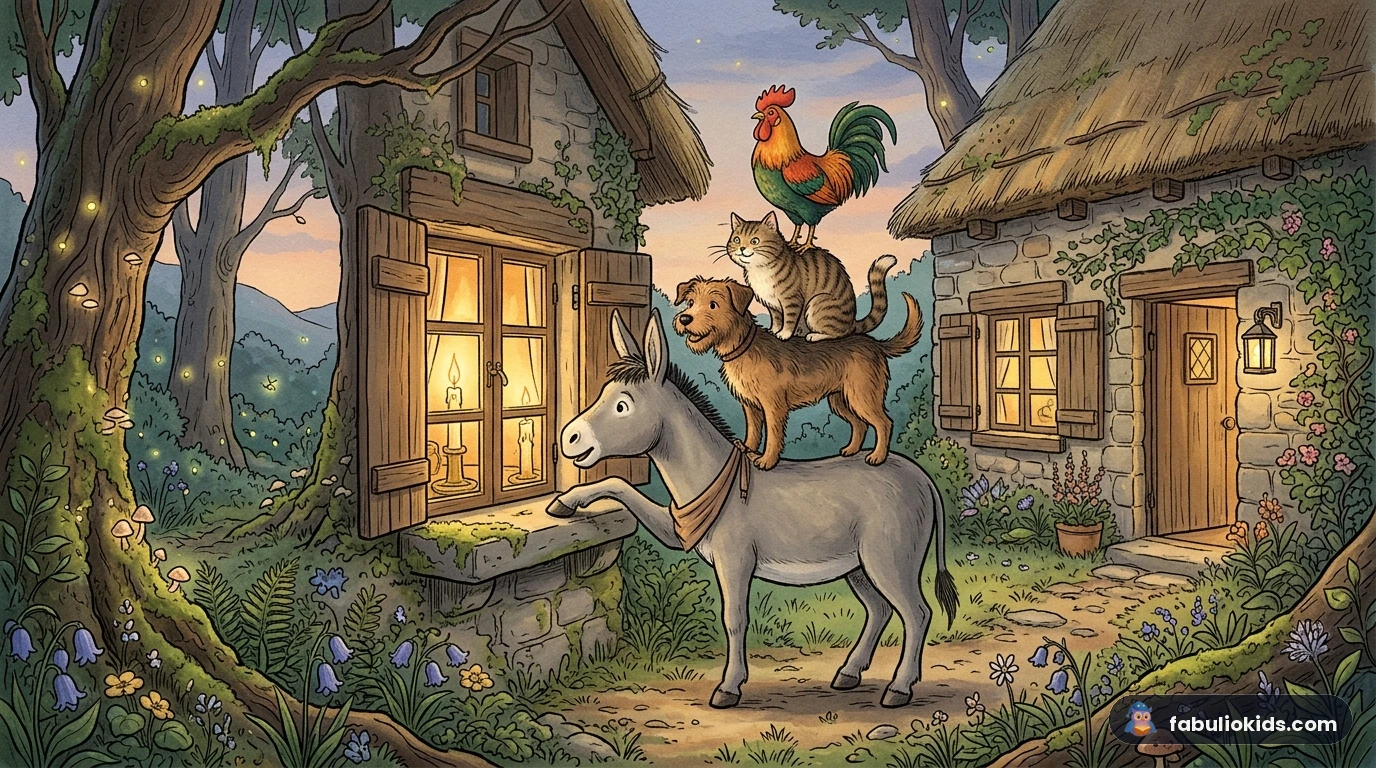
They walked on until they reached a stone cottage lit by a lantern. Through the window they saw robbers around a table laden with bread, cheese, and steaming soup. The four friends hatched a clever plan: the donkey placed his forehooves on the mossy sill, the dog hopped onto the donkey’s back, the cat climbed onto the dog, and the rooster perched lightly on the cat’s head.
On three, they sang together. The donkey brayed, the dog barked, the cat meowed, and the rooster let out a long cock-a-doodle-doo that swung the wooden shutter wide open. Thinking a four-headed ghost had arrived, the robbers bolted headlong into the woods.
The four musicians stepped inside, supped calmly, blew out the candle, and found snug corners to sleep: the donkey on soft straw under the porch, the dog behind the door, the cat by the warm hearth ashes, and the rooster on the high beam.
Later, the captain sent one robber back to check the house. He crept inside on tiptoe in the dark. Mistaking the cat’s glowing yellow eyes for live coals, he held a match near them: the cat puffed like a bellows and gave his nose a playful swipe. Startled, he stumbled over the dog, who nipped the toe of his boot; then he got a solid shove from the donkey under the porch and heard the rooster cry out from high on the beam. He ran back breathless, swearing a witch had scratched his nose, a giant behind the door had pinched his leg, a monster had shoved him with a club, and up high sat the judge, who called out, “Bring the rogue here to me!” The robbers never returned.
The little cottage belonged entirely to the four friends, wrapped in the scent of warm timber and clean straw beneath a high moon. None of them felt any need to set out the next morning for the distant squares of Bremen.
Under the quiet blanket of the night, the old dog rested his muzzle between his paws behind the door, and the cat shut her eyes near the still-warm hearth. The old ache of miles walked alone faded away with every steady breath, leaving only the comfort of sharing the same roof.
High upon the beam, the rooster tucked his head beneath one wing, and out under the porch the donkey sighed contentedly in the soft straw while a gentle breeze rocked the forest asleep until morning.