Puss in Boots
Before reading
This Perrault fairy tale is brisk, witty, and full of sparkle—ideal for ages four to eight right before the quieter slowdown of bedtime. Read the cat’s lines to the king and the ogre in a polite, confident voice so your child hears straightaway that his real strength lies in good humor and calm poise.
The miller’s youngest son inherited only a bright-eyed cat, while his older brothers received the mill and the donkey.
The young man sat sighing on the wooden step, wondering how he would ever get by. Yet the cat stretched himself, let out two warm purrs, and meowed firmly:
“Meow! Do not thus afflict yourself, my good master! Only give me a cloth sack with a drawstring and a pair of soft boots for walking through the meadows.”
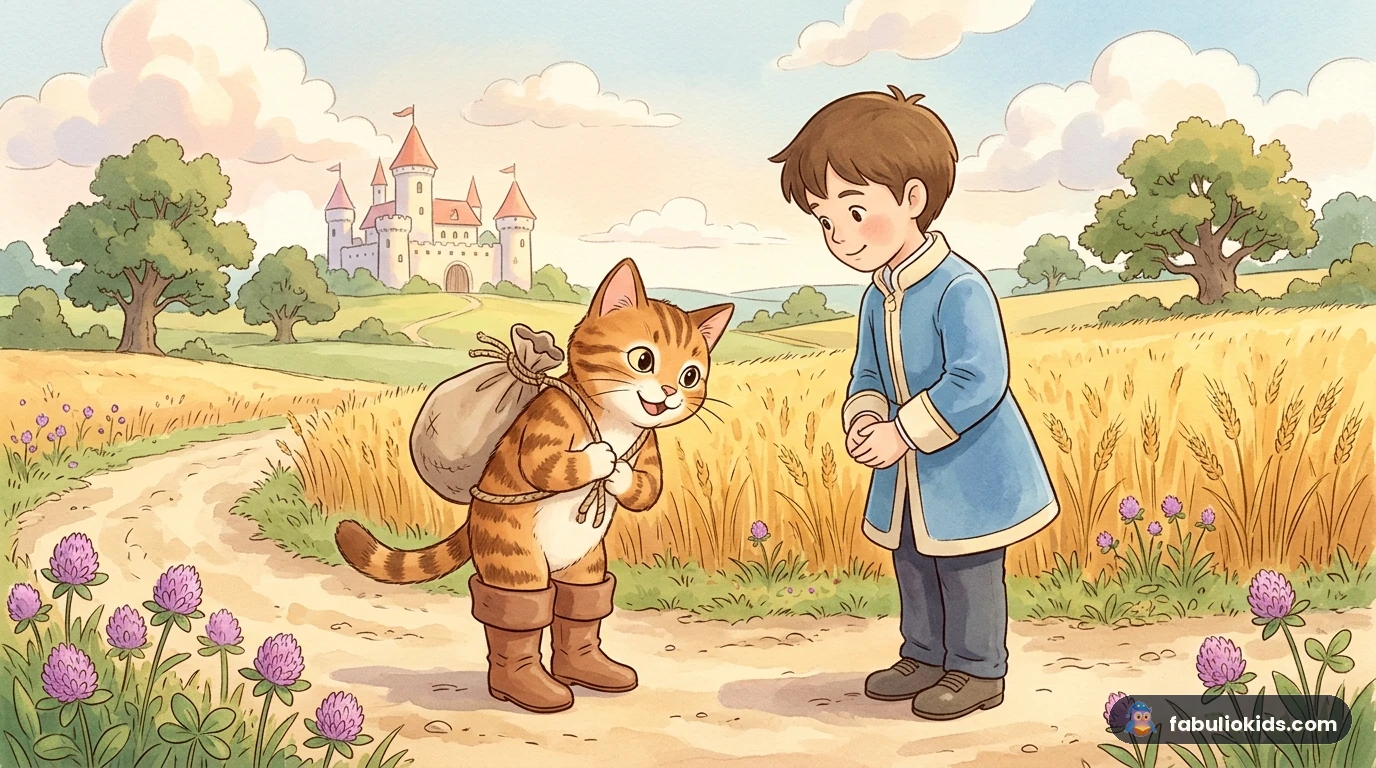
Curious, the youth granted his wish. Pulling on the glossy boots, the cat trotted into the woods, filled his sack with fragrant wild strawberries and sweet chestnuts, then marched straight to the king’s palace and asked for an audience.
“Your Majesty,” he said with a graceful bow, “my master, my Lord Marquis of Carabas, sends you this humble gift.”
Week after week the cat carried the finest fruits of the countryside to the king, always in the name of the mysterious Marquis, until the ruler grew fond of such courtesy.
One bright morning, the cat learned that the king and the princess would ride along the river road. He hurried to the young miller and persuaded him to wade into the cool water, hiding his worn clothes behind a boulder. As soon as he heard the trot of the great white horse at the head of the royal procession, the cat sprang onto the bank waving a paw.
“Help! Help! Someone has made off with the clothes of my Lord Marquis of Carabas!” he cried.
The king recognized the polite cat of the woodland gifts at once, ordered his guards to bring the youth a sky-blue velvet suit, and invited him to ride beside them along the meadow road.
Meanwhile, the cat bounded far ahead. Meeting the mowers cutting hay in the fields, he winked with a friendly smile.
“Good people, the king is passing by!” he whispered. “If you tell him these meadows belong to the Marquis of Carabas, tonight there will be a feast with sweet cakes for everyone!”
The farmworkers laughed warmly and gave that very answer as the royal party rode past, leaving the king more impressed than ever.
A little farther stood an enormous castle belonging to a wealthy, boastful ogre famous for his magic skill at changing shape. The cat knocked boldly, made an elegant bow, and asked whether tales of that wondrous magic were truly real.
“Of course they are!” boomed the ogre, puffing out his chest, and in a blink he turned into a great lion with a golden mane. The cat hopped lightly onto the windowsill until the ogre laughed and shifted back into himself.
“You are remarkable, sir,” purred the cat, smoothing his whiskers, “yet turning into something huge is easy for someone as grand as you. I wager, though, you cannot shrink into a tiny little creature—say, a mouse.”
“Impossible for me?” huffed the ogre, stung in his pride. No sooner said than done: he shrank into a small gray mouse with a pointed nose and let out a thin squeak across the parlor rug.
Swift as the wind, the cat clapped a wide upside-down wicker basket over him, then opened the garden door and lifted the rim just enough to let the little mouse scamper away over the garden wall toward the distant hills. Next he arranged fresh fruit, sweet cakes, and cups of honeyed milk upon the table to welcome the royal guests.
“Welcome, Your Majesty, to the castle of my Lord Marquis of Carabas!” announced the cat, flinging wide the great doors. When the king and princess stepped into the peaceful castle and saw the sunlit hall, the princess smiled at the miller’s son, who listened to her with gentle, simple kindness.
Looking out from a tall castle window, the youth rested one hand upon his cat’s shoulder and glanced down at the sleeves of his sky-blue velvet suit, remembering the wooden step of the old mill where everything began.
When evening settled softly over the stone towers, the glossy boots stood neatly beside the doorway next to the folded cloth sack.
Beneath the first stars glowing above the quiet wheat fields, the cat curled up upon a velvet cushion beside the cold hearth, letting the whole castle drift into the gentle rest of night.