The Lion and the Mouse
Aesop · Retold by Marko Nova · Age: 3-7 years · 4 min read

The Lion and the Mouse

Before reading

Clara Valenti

This fable from Aesop is brief, clear, and well suited even for three-year-olds, because the contrast between huge and tiny is grasped at a glance. In the original, the lion is ready to eat the mouse and hunters tie him up; here there is only a moment’s fright and a net found along the trail, so you can read it to the youngest without worry. I suggest reading it in a low voice whenever your child feels discouraged about not being able to do something alone, letting the slow cadence of the final lines bring the day to rest without speeches.

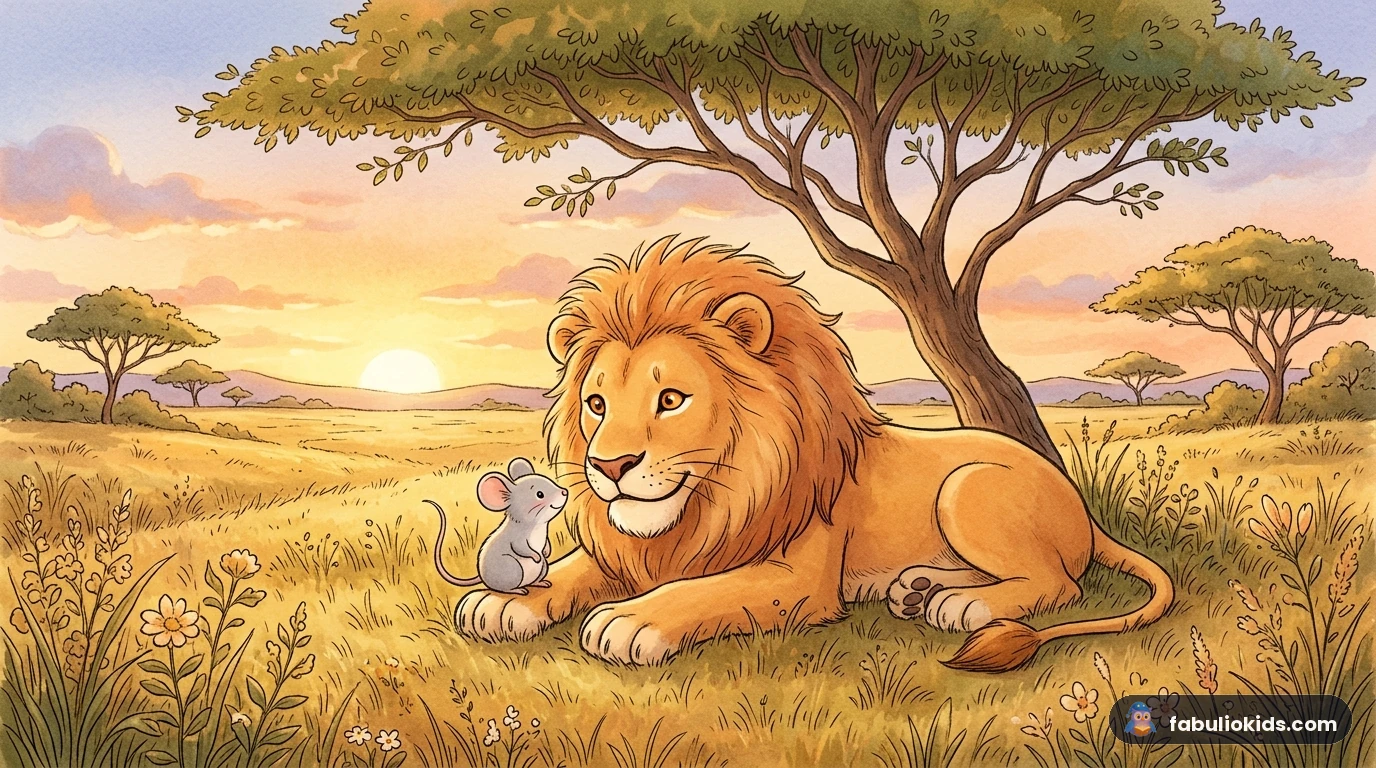
The great lion was resting through the afternoon in the broad shade of a golden acacia tree, his chin tucked upon his warm paws.

A little gray mouse, no bigger than a walnut, was hunting for seeds among the roots. Distracted by a blade of grass swaying in the mild breeze, she scurried, without looking, right across the lion’s muzzle and brushed his nose with her fine whiskers.

The lion opened his amber eyes and laid his huge paw over the little creature’s tail, holding her still against the earth. A thin squeak slipped from the mouse, and her whole tiny body trembled.

“Forgive me,” she whispered in the tiniest voice. “I did not mean to wake you. If you let me go, one day I will find a way to help you too.”

The lion looked down at the small gray bundle beneath his paw and let out a deep laugh that made the leaves quiver. “You, help me? Why, you are smaller than one of my yawns!” Then he lifted his paw gently and let her scamper off into the bushes.

Several quiet days passed, until one afternoon, while walking along a narrow trail, the lion stumbled into a sturdy net of twisted ropes. The harder he tried to pull free, the tighter the knots drew around his shoulders.

The lion let out a long roar that carried across the clearing. Hidden in the grass, the mouse knew that voice at once and hurried toward the sound, dropping the seeds she had gathered.

When she saw the great lion held fast among the thick cords, she was not frightened by the size of those knots. She climbed onto the rough rope and set to work with her small, steady teeth: one strand after another, without haste.

The lion lay still and watched her in silence, even holding his breath so as not to disturb those tiny teeth at work.

Strand by strand, the first cord parted with a faint snap, then the second, then the third, until the net gave way and the lion could slip free at last.

The great animal bowed low to the grass, resting his warm muzzle beside his small friend, who caught her breath on tired little paws until her heart returned to a calm beat.

When the sky over the plain turned the color of honey and soft shadows drifted behind the hills, the two walked side by side toward the tall acacia.

The mouse paused outside her burrow among the roots, while the lion stretched out nearby upon the cool grass, closing his eyes with a long, peaceful breath beneath the first stars of night.

Gentle guidance for parents

Guidance by Clara Valenti

1. What the story teaches your child

Watching the tiny mouse untangle the great net holding the lion with her small teeth lets your child discover that no strength is ever too small to matter to the people we love.

2. Practical insight for parents

Between the ages of three and seven, children measure everything by height and strength, so they often feel powerless next to the things grown-ups do, just like the mouse beside the lion. Small gestures matter too, as long as we notice them without comparing them to what grown-ups do: give your child one real, manageable job in the evening routine, like switching off the lamp or folding the blanket, and offer sincere thanks for the help.

3. A gentle question for tonight

  • What small kind gesture did you manage to offer today, even if it felt like nothing at all?

Behind the tale

Where this tale comes from

The Lion and the Mouse is one of the best-known fables of the ancient Greek Aesopic tradition, listed as number 150 in the Perry Index under the title Λέων καὶ μῦς ἀντευεργέτης (The Lion and the Mouse Who Repays a Favor). Over the centuries it traveled across Europe: Jean de La Fontaine set it in verse in 1668 (Le Lion et le Rat), and it entered English households through collections such as George Fyler Townsend’s Three Hundred Æsop’s Fables (1867). It is a remarkably brief tale carved into shared memory, built on a vivid visual contrast between the lion’s vast mane and a mouse no larger than a walnut.

Why it has lasted for centuries

Children love the sudden reversal of roles: the tiny, trembling creature pinned beneath a giant paw becomes the only one able to set the stronger friend free. No magic and no brute force are needed—only an attentive ear when a distant roar rings out and the patient steadiness to nibble one cord at a time.

For the grown-up reading beside the pillow, the fable strikes a quiet, honest chord. In the weariness of everyday life it is easy to feel like that lion: accustomed to carrying everything alone, convinced we must always be the ones who protect and provide. The story gently reminds us that letting little ones help us does not make us weaker; it gives us room to breathe.

What we changed and why

  • We kept the hunters offstage, showing only the net of twisted ropes along the trail, so there are no weapons, violence, or needless fear before sleep.
  • We softened the lion’s opening threat into a brief startle followed by a warm laugh that immediately melts the tension.
  • We removed both the mouse’s lecturing closing line and the explicit moral, letting gratitude speak through peaceful companionship at dusk.

Sources

Original work

Aesop, Λέων καὶ μῦς ἀντευεργέτης (Aesop’s Fables (Aesopic corpus)), -600

Edition consulted: Greek Wikisource, Αἰσώπου Μῦθοι / Λέων καὶ μῦς ἀντευεργέτης

https://el.wikisource.org/wiki/%CE%91%CE%B9%CF%83%CF%8E%CF%80%CE%BF%CF%85_%CE%9C%CF%8D%CE%B8%CE%BF%CE%B9/%CE%9B%CE%AD%CF%89%CE%BD_%CE%BA%CE%B1%CE%B9_%CE%BC%CF%85%CF%82_%CE%B1%CE%BD%CF%84%CE%B5%CF%85%CE%B5%CF%81%CE%B3%CE%AD%CF%84%CE%B7%CF%82

The basis of this version

George Fyler Townsend, 1867

https://en.wikisource.org/wiki/Three_Hundred_%C3%86sop%27s_Fables/The_Lion_and_the_Mouse

More classic fairy tales

Classic fairy tales · Stories