The Three Little Pigs
Before reading
This traditional Jacobs version is wonderfully lively and works best just before the evening sleep routine, when children aged three to six still want to join in with their voices. I recommend letting your child chime in on the chant behind the door and laugh together over the rolling butter-churn, then gently lowering your voice through the final three paragraphs beside the warm hearth.
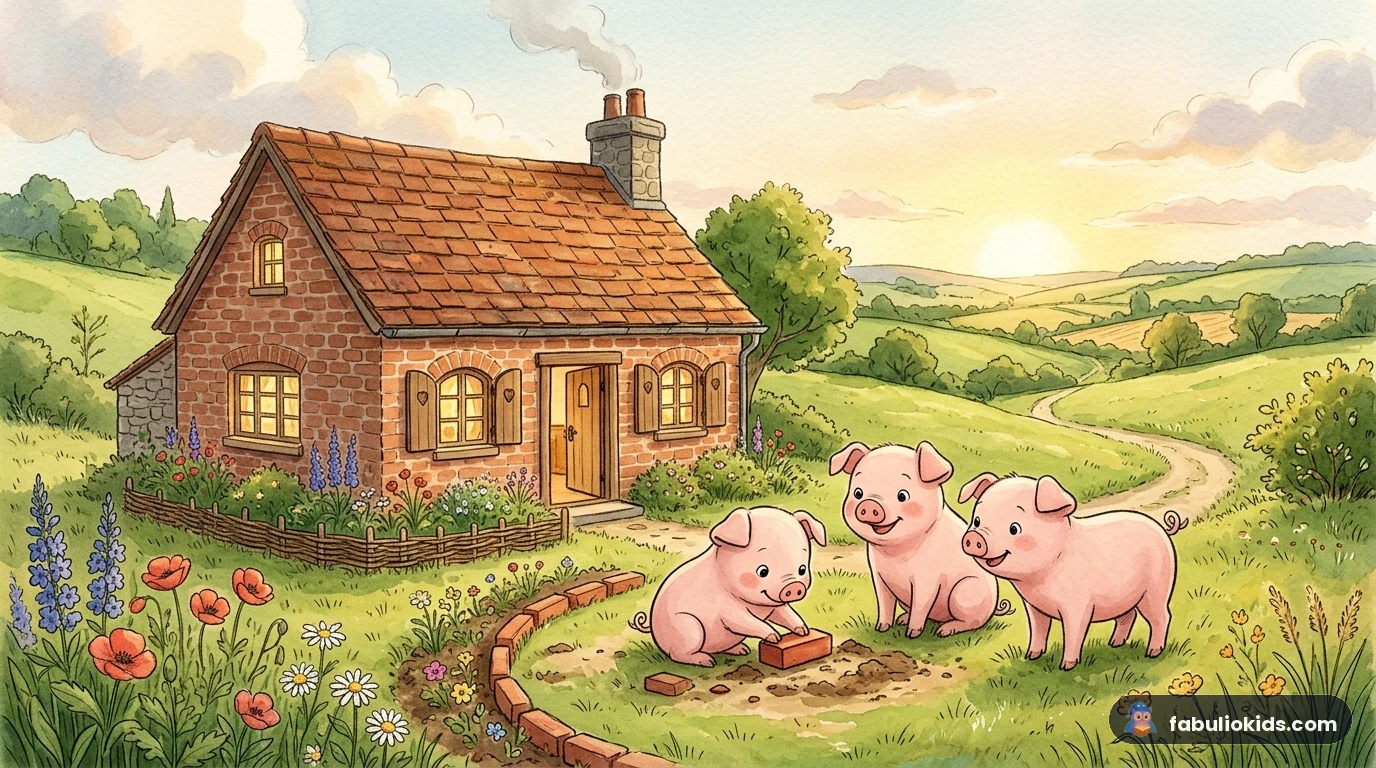
Three little pig brothers waved good-bye to their mother on the doorstep and set out together down the country lane to seek their fortunes and build each his own little house.
The first soon met a farmer carrying a great bundle of yellow straw. “Please, good man, give me that straw to build a house,” he asked cheerfully. So in a single afternoon he raised a golden hut as light as hay and stretched out at once to rest in the grass.
The second little pig walked farther and met a woodcutter carrying a bundle of dry furze and sticks. With those he quickly wove a fragrant woodland house of twigs. The third brother walked on still farther, met a carter with a load of red bricks, and worked patiently until sunset to raise straight, sturdy, well-finished walls. As he set the very last brick with mortar-dusted trotters, it felt to him as though each wall laid with care were already half a warm blanket for winter days.
The next day a hungry wolf arrived outside the straw house and knocked at the door: “Little pig, little pig, let me come in.”
“No, no, by the hair of my chiny chin chin,” answered the pig from behind the window.
“Then I’ll huff, and I’ll puff, and I’ll blow your house in.” So the wolf drew breath and let out one mighty puff long enough to scatter the straw like feathers across the meadow. The first little pig did not wait a second and scurried with quick footsteps to the second brother’s stick house, shooting the bolt tight behind him.
Before long the wolf arrived there too and knocked loudly: “Little pigs, little pigs, let me come in.”
“No, no, by the hair of our chiny chin chins!” cried the two together.
“Then I’ll huff, and I’ll puff, and I’ll blow your house in.” The wolf huffed and puffed twice with swollen cheeks, and the twigs blew across the grass. Both brothers raced swiftly up the hill to the brick house, where the third welcomed them straight inside and dropped the heavy iron bar across the door.
When the wolf reached the red brick cottage, he knocked again: “Little pigs, little pigs, let me come in.”
“No, no, by the hair of our chiny chin chins!” all three answered together.
“Then I’ll huff, and I’ll puff, and I’ll blow your house in.” Well, he huffed and he puffed, and he puffed and he huffed three times in a row, yet the brick cottage never trembled by even a finger’s breadth.
Then the wolf changed his plan and tried cleverness instead. He stepped up to the window with a honeyed voice: “Little pig, I know where there is a nice field of sweet turnips down yonder. If you like, we will go together tomorrow at six o’clock.”
“With pleasure!” replied the third little pig. Yet the next morning he woke up at five sharp, filled a basket with tender turnips, and returned home before the wolf even poked his nose out of his den.
When the wolf found out, he grumbled crossly and tried another invitation: “There is a fair on the hill at three today—will you come?” Instead, the little pig set out at noon, bought a big round wooden butter-churn, and was heading home at the top of the slope when he saw the wolf coming round the bend below. Without being seen, the clever little pig climbed inside the butter-churn and let it roll down the hillside. Down bounded the churn over the grass with such a comical clatter that the wolf’s eyes went wide, sure a round monster was chasing at his heels, and off he bolted behind the trees.
Back by the brick cottage at evening, the wolf climbed onto the roof to slide down the chimney. The third pig heard him scraping on the tiles and set a wide tub of soft ash and cool water onto the unlit hearth. Down slid the wolf and landed in the tub with a splash; the third pig flung open the door, and out dashed the wolf, gray with soot, running off toward the hill without the slightest harm.
Safe from the fright, the three brothers laughed heartily, lifted away the tub, and then lit a small, cheerful fire in the hearth.
While the soft blue of night settled outside, the three little pigs shared warm bowls of turnip soup beside the quiet embers.
At last they blew out the lantern on the table, tucked in the woolen blankets in their cozy room, and fell asleep side by side beneath the safe roof of their red bricks.