The Sleeping Beauty in the Wood
Before reading
Perrault’s tale, freed from its darker second half, becomes one of the quietest stories in our catalog, ideal from age four upward as the very last story before lights out. My advice is to keep your voice calm from beginning to end, slowing especially as the castle drifts to sleep alongside the princess so rest arrives like a shared embrace.
Seven solid-gold cases sparkled down the king’s long banquet table on the day the long-awaited princess was born.
For the christening, the king and queen had invited all seven fairies of the land as godmothers, placing before each a golden case holding a spoon, fork, and knife set with jewels. Yet as the guests took their seats, an eighth fairy, a very old one who had not left her tower in fifty years, entered the hall. The king quickly had a place laid for her too, though only seven golden cases had been made. Feeling left out, the old fairy muttered a few sharp words under her breath. One of the young fairies heard her and slipped behind a tapestry so she might speak last.
One after another, the six fairies gave the baby beauty, wit, grace, nimble dancing, a nightingale’s voice, and skill in music. When the old fairy’s turn came, she shook her head in spite and foretold that one day the princess would prick her hand on a spindle and die.
A chill swept the hall, yet the seventh young fairy stepped straight out from behind the tapestry. “Take heart, Your Majesties,” she said clearly. “I cannot undo the whole spell, yet I can soften it: the princess will prick her hand, but instead of dying she shall fall into a calm sleep of one hundred years, and when the time is full a king’s son will come to wake her.”
Out of caution, the king forbade anyone in the kingdom to keep spindles at home. Fifteen quiet years passed by. One afternoon while her parents rode out through the royal gardens, the young princess climbed curiously up the spiral stairs of an ancient tower to a silent attic. There sat a kindly old woman spinning wool with a spindle, having never heard of the king’s decree.
“What pretty work!” said the princess, stepping nearer. “May I try?”
As soon as she took the smooth wooden spindle between her fingers, she pricked her hand and closed her eyes in a peaceful slumber. The old woman called at once for help; the king remembered the prophecy and had his daughter laid in the brightest chamber upon a bed embroidered with gold and silver, where she breathed softly with rosy cheeks.
The seventh fairy returned upon a gentle breath of wind. Thinking how lonely the girl would feel waking up after a century among strangers, she touched every soul and corner of the palace with her wand except the parents: ladies-in-waiting, cooks in the kitchen, guards at the gates, the little dog curled at the foot of the bed, the birds beneath the eaves, and even the hearth fire, which lowered its sparks and drifted calmly to sleep.
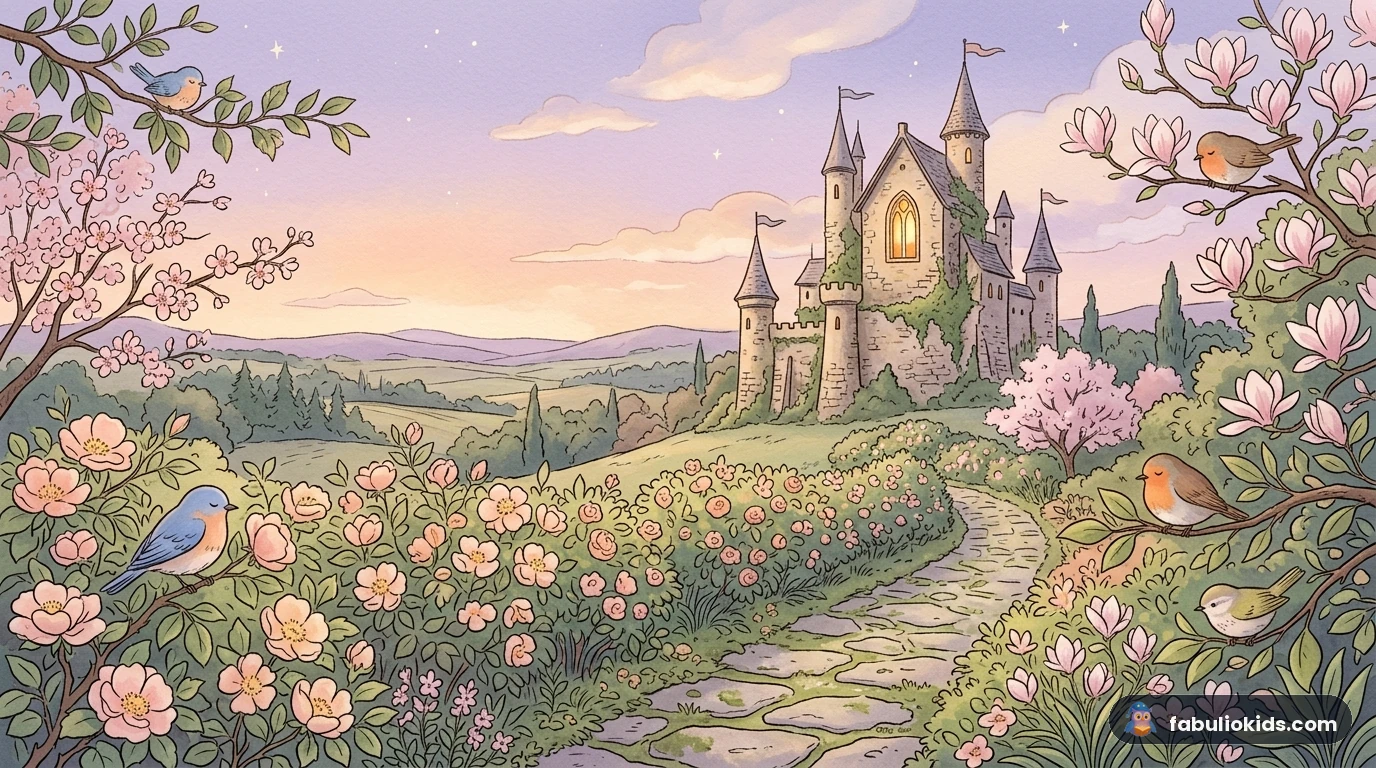
The king and queen kissed their daughter’s forehead softly and went out beyond the walls. Behind them, all around the park, there sprang up a thick hedge of trees and pale wild roses that guarded the towers in stillness, and the two of them kept looking back until the blooming hedge hid the towers completely.
One hundred years went by. One day a young prince, guiding his horse at an easy walk along the country lane, glimpsed the slender towers above green treetops and heard from an old farmer the story of the sleeping princess.
As soon as the prince drew near the hedge, the leafy branches and pale roses parted smoothly on their own to open a soft path. He crossed the quiet courtyard, passed the guards snoring softly, still standing at their posts, and climbed to the golden chamber. As he knelt beside the bed, the hundred years were fulfilled at that very moment: the princess opened her wide eyes and gave him a serene smile. “Is it you, my prince?” she murmured in a rested voice. “You have kept me waiting a little while.”
At that same instant the entire castle drew a quiet breath again, while the fire flickered softly back to life in the hearth and the little dog wagged its tail sleepily upon the quilts.
Outside the windows open to the twilight, the birds began chirping lightly once more among the pale blossoms of the hedge swaying in the warm evening breeze.
The princess stood by the window, holding the prince’s hand, and looked out over the still garden, where every leaf and stone seemed freshly rested after a hundred-year sleep.