Hansel and Gretel
Before reading
This is a vivid fairy tale well suited for ages five to eight, when a child can already bear a stretch of suspense between the forest and the return home. I suggest reading the walk among the trees in a steady, reassuring voice and savoring the sweet cottage and the white duck: knowing that brother and sister stay side by side helps your child experience the adventure as a challenge overcome as a team.
At the edge of a great forest stood a small wooden cottage, where at evening only a few crumbs of bread remained upon the table.
There lived a poor woodcutter with his wife and two children, Hansel and Gretel. During a long famine the breadbox emptied completely, and one night the parents, frightened by a hunger that left them no way out, decided with heavy hearts to lead the children the next day to a distant clearing, hoping they might gather sweet berries there or meet kind travelers able to help them.
Hansel, however, was still awake. He slipped out the door in the moonlight, filled his pockets with white pebbles that shone before the threshold like silver coins, and crept back under his blanket. The next morning he dropped the stones one after another along the path, and when the grown-ups walked away among the trees, the brother and sister waited for the moon to rise and followed that bright trail all the way home.
A few days later the famine grew harder still. This time the door was locked, so Hansel could carry only a dry crust of bread in his pocket. Walking toward the clearing, he broke it into tiny crumbs along the grass, but behind them came flocks of woodland birds that pecked up every last crumb. When evening fell, Hansel and Gretel could no longer find the path.
They walked on until morning, guided by a bird as white as snow, until they came upon a little house unlike any they had ever seen: its walls were made of fragrant gingerbread, its roof of soft cake, and its windowpanes of clear shining sugar.
Hungry, Hansel broke off a piece of the roof and Gretel tasted a corner of the sweet window. At once a thin voice called from inside: “Nibble, nibble, gnaw, who is nibbling at my little house?”
“The wind, the wind, the heaven-born wind!” answered the two children laughing.
The door opened and out stepped a greedy, grumpy old witch who invited them inside with promises of pancakes and warm milk. Yet the next morning she showed her true plan: she wanted to keep the children to work day and night kneading sweets for her alone. She shut Hansel inside a wooden storeroom while Gretel had to sweep and prepare trays of cookies. Every evening the old woman came to the little window of the room to feel the boy’s wrist and see if he had enough strength to lift the baker’s peel, yet Hansel cleverly held out a dry twig in the dark, so she huffed and put it off again and again.
One afternoon, however, the witch lost her patience and decided to put them both to work at once. Just as she opened the pantry stacked with honey jars, a quick idea flashed through Gretel’s mind.
“Grandmother, way back there stands a tall jar of golden honey,” she said, pointing to the farthest shelf, “and I am too short to see whether it is full.”
The witch muttered and stepped inside the pantry. In a flash Gretel pushed the heavy door shut and slid the iron bolt across, leaving the old woman grumbling safely among the sugar jars. Then she freed Hansel, and together they took a bundle of sweet bread and a small pouch of shiny pearls resting on the cupboard.
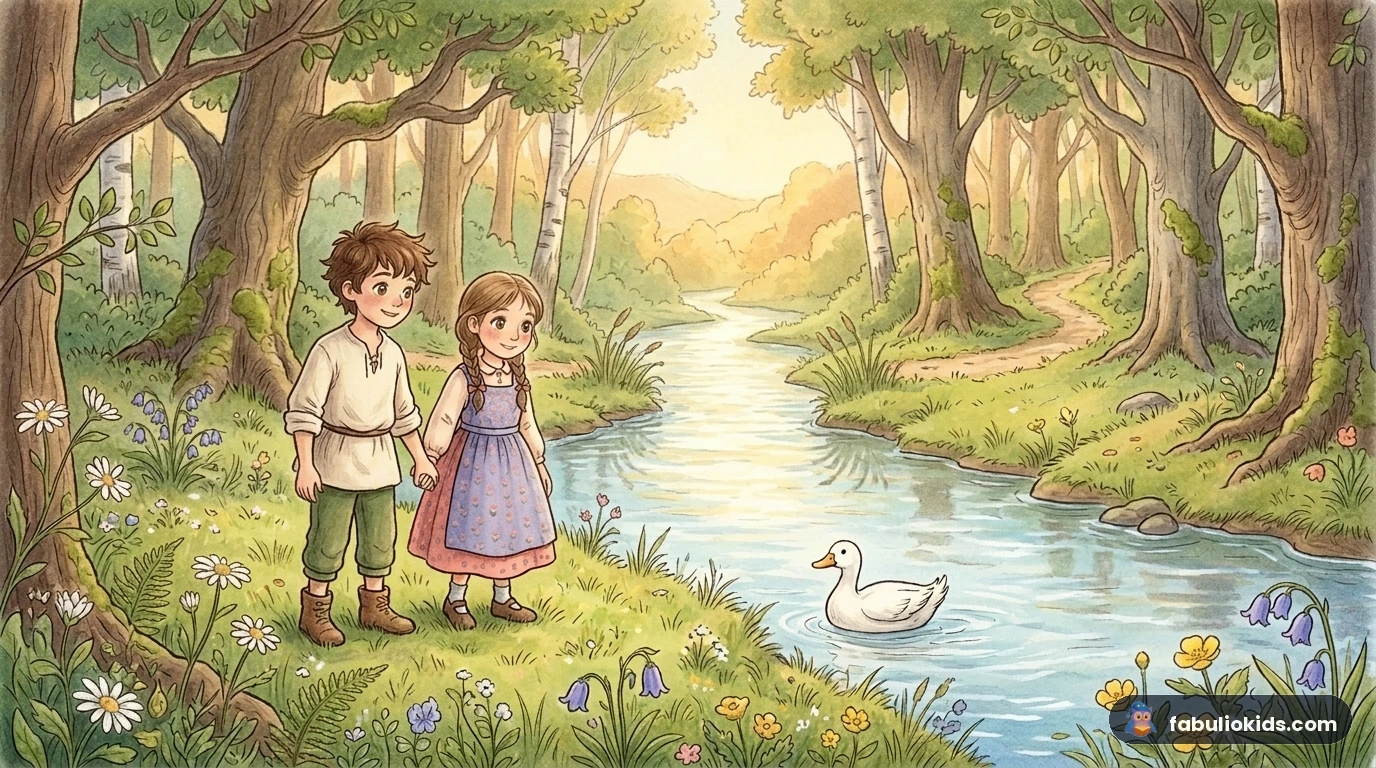
On the way home they reached a wide stream brimming with clear water, with neither plank nor bridge. Near the bank a lovely white duck floated calmly.
“Little duck, little duck, dost thou see? Hansel and Gretel are waiting for thee. There’s never a plank or bridge in sight; take us across on thy back so white,” called the sister gently.
The duck agreed, and Gretel let her brother ride first by himself so the living feather-boat would not carry too much weight, then crossed right after him. On the far side they knew at once the trees near home.
As they ran down the last stretch of the path, their father rushed out the door with tears in his eyes and hugged them both tight against his jacket smelling of wood and moss; right behind him ran their mother, weeping too, and together they promised never to part again.
That evening the little kitchen smelled once more of warm soup and freshly broken bread, while the white pebbles resting before the doorway softly reflected the lantern light.
Seated together at the wooden table, brother and sister listened to the steady breathing of the house drifting toward rest, with no more hurry and no dark roads left to search.
Outside, the forest stood still beneath the high stars, and in the warm room sleep settled softly like a blanket pulled up to the chin.