Little Red Riding Hood
Before reading
From ages three to seven, Little Red Riding Hood is one of the first classics where a child senses the difference between keeping an agreement and getting sidetracked along the way. I suggest reading the questions about big ears and big eyes in a light, slightly theatrical voice: the moment the huntsman opens Grandmother’s wardrobe, your child shares in the relief and settles happily for sleep.
The little cloak of red velvet sewn by Grandmother lay neatly folded on the kitchen chair, ready with its soft hood for the morning walk.
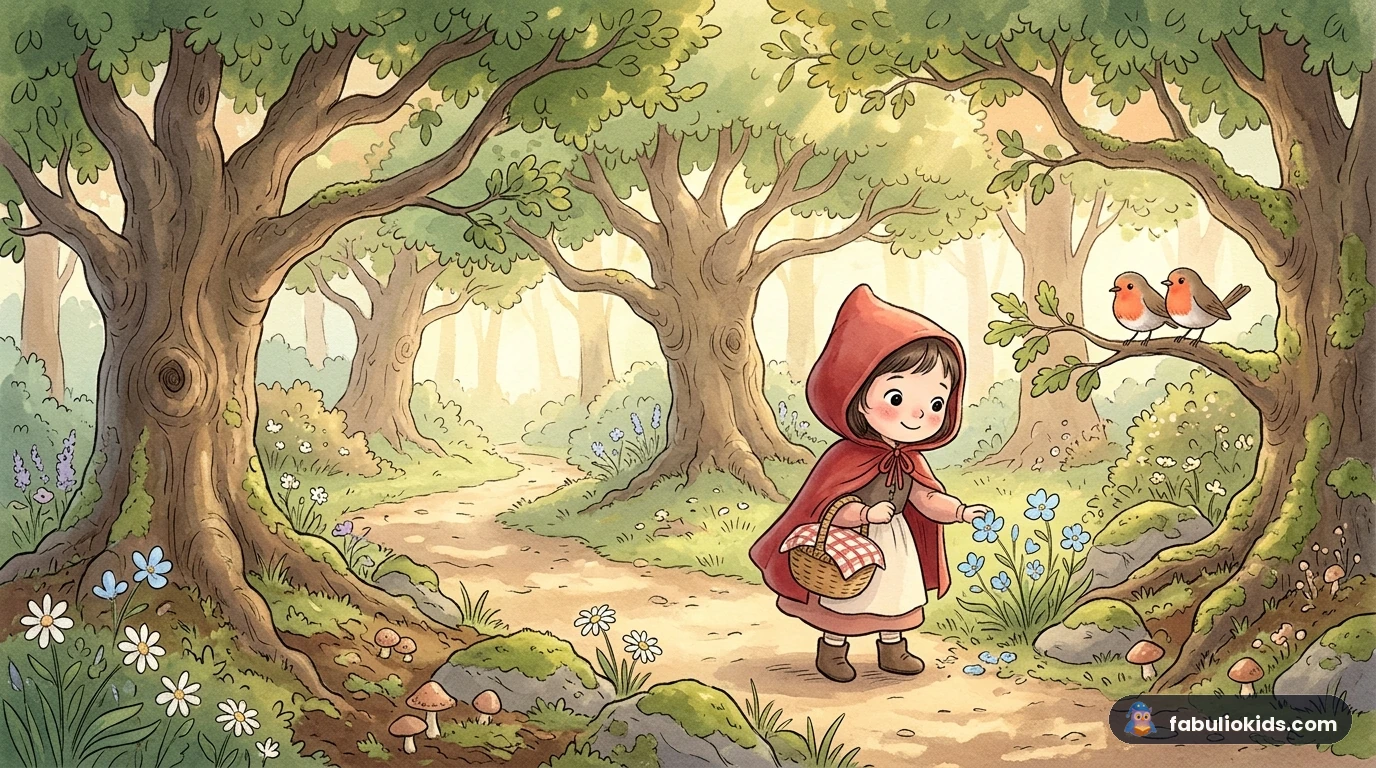
Whenever the little girl slipped it over her shoulders, it suited her so well that everyone in the village called her Little Red Riding Hood. That morning her mother packed a wicker basket covered with a checkered cloth, placing inside a soft freshly baked cake, a jar of honey, and fragrant bags of herbal tea.
“Take these to Grandmother beneath the three great oaks,” she said, tying the ribbon of the cloak. “Walk nicely and quietly, with steady steps along the path, and don’t stop to chat with strangers.”
In the woods the air was crisp, and among the branches the robins sang as they hopped from leaf to leaf. Halfway along the trail, a gray wolf with scruffy fur and a curious snout stepped out from behind a bush, already catching the sweet scent of the cake from afar.
“Good morning, Little Red Riding Hood,” he said in a honeyed voice. “Where are you hurrying off to with such a fine basket?”
“I am going to visit Grandmother under the three oaks,” answered the little girl without thinking twice.
“Just look at all those sky-blue flowers over here, and listen how sweetly the birds are singing!” said the wolf, pointing with one paw. “A little bouquet would make your grandmother so happy.”
Little Red Riding Hood stepped off the path and bent to gather daisies and bluebells, while the wolf took a shortcut between the trees and ran straight to Grandmother’s cottage. He knocked at the door, putting on a thin little voice, slipped swiftly inside, and—to claim the whole bed for himself while waiting for the basket of sweets—hurried poor Grandmother into the big wooden wardrobe and turned the key. Then he put on her lace nightcap, pulled the blankets up to his nose, and waited.
Before long, Little Red Riding Hood arrived with her basket and her bunch of flowers. She found the door slightly ajar and stepped closer to the bed with a touch of hesitation, for Grandmother looked terribly funny beneath her cap.
“Grandmother, what big ears you have!” she said, moving slowly nearer.
“The better to hear you with, my child!” replied the wolf, trying to soften his gruff voice.
“And what big eyes you have!” continued the girl, squinting hard.
“The better to see you with, my dear!”
“Oh, Grandmother, what a big mouth you have!” cried Little Red Riding Hood, taking one small step back.
“The better to eat up your whole cake in one gulp!” shouted the wolf, springing out of bed toward the basket.
At that very moment the door swung wide open: a passing huntsman, who had spotted the wolf’s tracks beneath the oaks, gave a sharp whistle and raised the sturdy broom leaning beside the doorway. Startled out of his wits, the wolf dropped the untouched basket at once, leaped straight out the low window, and scampered far over the hills without ever looking back.
The huntsman turned the wardrobe key right away, and out stepped Grandmother, a little ruffled yet smiling broadly, eager to hug her granddaughter and thank their rescuer who had arrived just in time.
Once the huntsman waved goodbye and went back along the trail, Grandmother brewed a pot of warm herbal tea and cut two soft slices from the cake still safe inside the basket. Seeing the red hood neatly folded on the chair beside her own woolen shawl, Grandmother poured the steaming tea with steady hands, glad to hear the light breathing of her granddaughter close beside her.
Seated together around the kitchen table while the light outside turned the color of honey, they spoke softly of the walk beneath the oaks, the sky-blue flowers gathered in the woods, and the calm rustle of the wind before evening fell.
Then Grandmother laid a gentle, tender caress upon the little girl’s cheek, and the cottage filled with quiet while the forest outside drifted off to sleep.