Cinderella
Before reading
I chose Perrault’s version because, unlike the Grimm variant with no fairy godmother and harsh physical punishments, it places grace and sincere forgiveness at the center without frightening scenes. It works wonderfully from age four upward, especially on evenings when a child needs space to talk about small jealousies or being left out during the day, leaving aside animated-film details so the original images stay fresh.
In the quiet of the evening, when the great house fell still, the warm glow of the fire on the hearth softened Cinderella’s cheeks as she set her broom beside the cooling ashes.
That wide kitchen smelled of vegetable broth and beechwood smoke, and her hands always wore a pale grey veil of dust. Her stepmother left her the stone stairs to scrub and the dishes to dry, while her two stepsisters spent hours before tall mirrors trying on satin ribbons. Yet whenever her father was away and hush settled over the flagstones, she sat down upon the lowest hearth step, breathed slowly, and never let the harshness of others slip into her own voice.
One autumn evening an invitation arrived from the King’s son for two grand balls at the palace. The two stepsisters chose ruffled bonnets and asked Cinderella herself to dress their hair and lace their bodices. She did so with light, steady fingers and never a bitter word. When the three women’s carriage rolled away into the mist along the drive, the kitchen felt vast and empty. Sitting beneath the old pendulum clock that ticked slowly against the wall, Cinderella felt a warm tear trace down her cheek.
“Why are you crying, little one?” asked a gentle voice behind her.
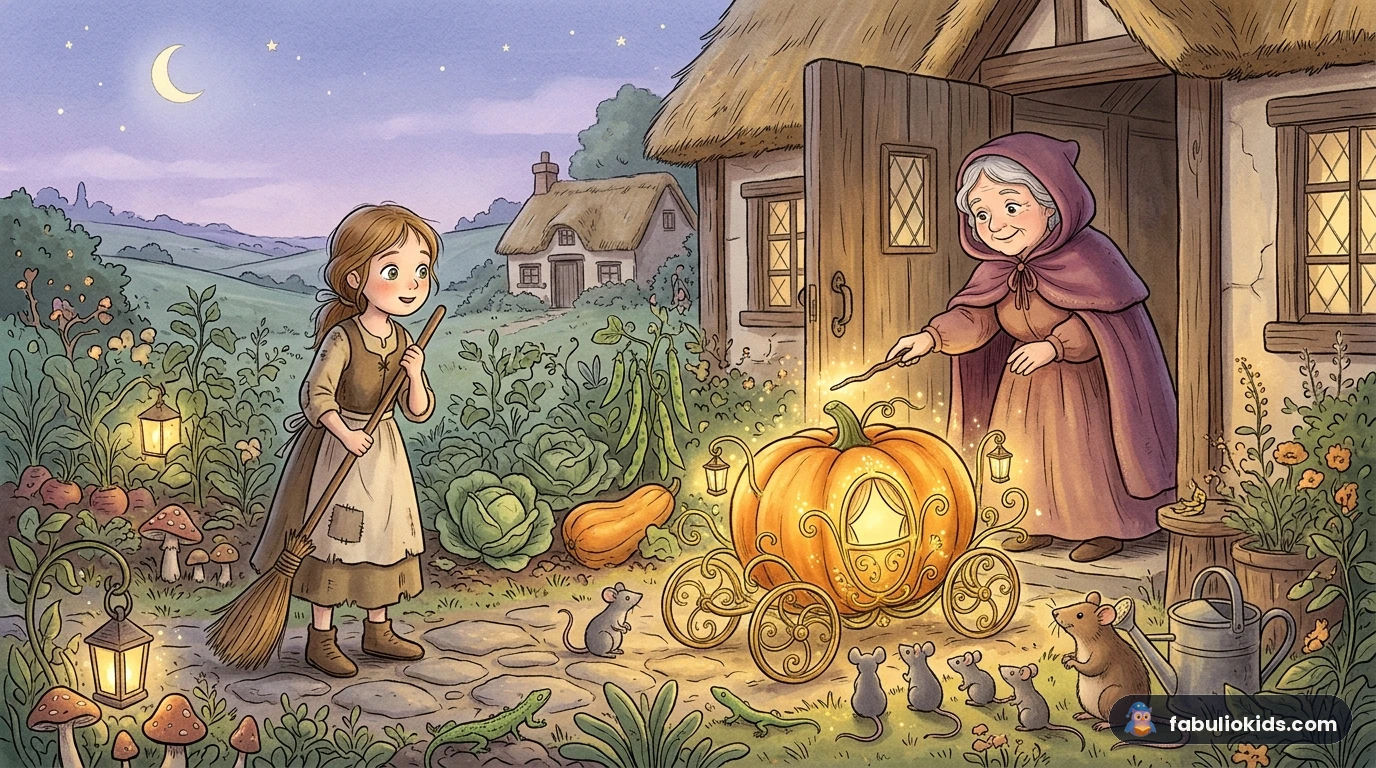
There stood her fairy godmother, dressed in a plum-colored cloak and holding a slender wand of pale wood. Understanding her wish at once, she sent Cinderella out to the garden for a plump orange pumpkin. The godmother hollowed it carefully down to the rind, tapped it with her wand, and the pumpkin turned into a coach gilded all over with real gold. Next she opened a closed basket in the pantry where six little grey mice slept huddled together: at one light touch they became six dapple-grey horses, ready to step briskly. A stout rat with long whiskers became a plump coachman in a glossy coat, and six green lizards dozing behind the watering can turned into six footmen in green and gold livery.
At last her godmother touched Cinderella’s worn linen clothes. The frayed seams vanished in a shower of quiet sparks, leaving behind a gown woven of gold and silver, light as moonlit mist, and two tiny slippers of clear glass.
“Remember only this,” the fairy whispered at the doorway. “You must come home before midnight strikes, for at the last stroke everything will return to what it was before.”
At the first ball, no one recognized the girl from the hearth. The prince danced with her for hours, yet Cinderella did not forget her stepsisters seated at the edge of the hall: she walked over with a calm smile and offered them the fragrant oranges and citrons the prince had just given her. Before midnight, she returned in good time to the warm embers of her kitchen.
On the second evening the ballroom shone with a thousand candles, and the music seemed to pause time itself. Cinderella felt so warmly welcomed that she forgot the hour. Only when the first chimes of midnight rang from the palace tower did she spring toward the marble staircase. She fled away lightly, and in her haste one little glass slipper fell from her foot upon the moonlit step. Outside in the night air she found herself in her old linen clothes again, yet deep inside her apron pocket she felt the smooth, cool curve of the other glass slipper.
A few days later, the crisp sound of hooves on the cobblestones announced the prince’s heralds, carrying the lost slipper upon a velvet cushion. Both stepsisters tried with all their might to squeeze a foot inside, without success. When Cinderella’s turn came, the slipper slid onto her foot effortlessly, and from her pocket she drew out its twin, showing everyone that both belonged to her.
At that moment her fairy godmother appeared once more, and the simple kitchen filled with a calm, golden light. The two stepsisters lowered their eyes and asked her forgiveness for every sharp word spoken in the months gone by. Cinderella folded them into a long, sincere embrace; then the prince took her hand and led her with him to the castle.
That night the castle rested in deep silence beneath a sky bright with great stars, and the tall windows let only a pale silver glow drift across the polished floors. The glass slippers stood neatly beside the bed, alongside the memory of a quiet supper and hands finally washed clean of ash. Everything around grew slow, soft, and safe as gentle sleep floated down like a warm veil over the world.